
Magento 2 Latest Version Guide: What 2.4.9 Means for Your Store
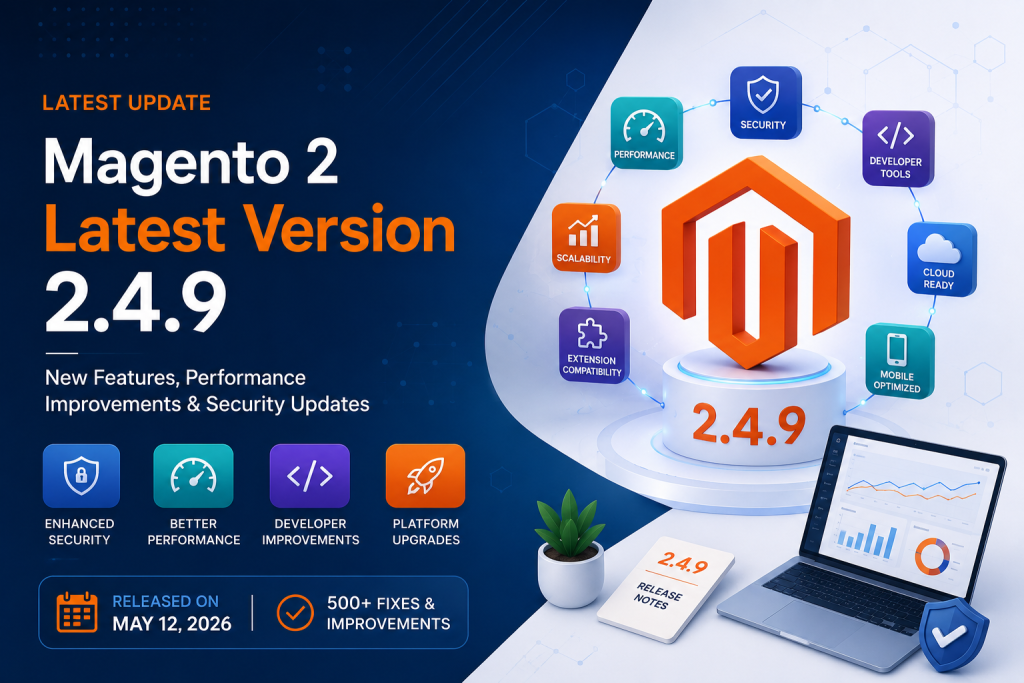
If you run Magento day to day, release notes can feel like a wall of version numbers. This guide is the opposite of that. We pulled together what actually matters about the latest Magento 2 line — 2.4.9 (released 12 May 2026) so founders, store managers, and tech leads can decide what to do next without copying anyone else’s article word for word.
Public release calendars from Adobe, plus community roundups, all point to the same headline: 2.4.9 is the current stable line, with regular support planned through May 2029. Older 2.4.x lines still get patches for a while, but 2.4.9 is where new platform work is landing.

Quick answer: what is the latest Magento version?
Magento Open Source / Adobe Commerce 2.4.9 is the newest minor line as of May 2026. Adobe’s released-versions page lists the 2.4.9 line with a release date of 12 May 2026. If your team still says “we’re on 2.4.7” or “2.4.8-p2,” you are not on the latest line — you may still be secure if patches are current, but you are behind on infrastructure support.
Think of Magento versions like this:
- Minor lines (2.4.7, 2.4.8, 2.4.9) — bigger platform jumps
- Security / patch releases (2.4.8-p1, etc.) — stay current within a line
- End of regular support — when Adobe stops routine fixes for that line
Why 2.4.9 feels bigger than a routine update
Most Magento patches fix bugs and close security holes. 2.4.9 also reshapes the stack your store sits on. That is good news for longevity — and a reason not to “click upgrade on Friday night.”
PHP: plan for 8.4 or 8.5
2.4.9 drops older PHP. In practice, teams should treat PHP 8.4 or 8.5 as the production target. PHP 8.3 may still show up for upgrade paths, but it is not the place you want to live long term. If your hosting contract or Docker images are still pinned to 8.2, that conversation needs to happen before Composer even starts.
Search and cache: OpenSearch 3 and Valkey
Search is moving firmly toward OpenSearch 3.x. If you still have Elasticsearch habits in runbooks, update them. On the cache side, Adobe’s direction is Valkey as the supported cache backend path (Redis configurations are familiar to many teams, but the supported default story has changed). For ops, that means staging should prove cache + session behaviour before go-live — not after.

Framework and admin editor changes
Under the hood, Magento continues the long migration away from older Zend/Laminas pieces toward modern Symfony components (including cache). Admin content editing also moves forward — TinyMCE is no longer the long-term story; newer editor packaging lands in this line. Custom modules that still type-hint removed classes are the usual upgrade surprises.
GraphQL and headless shops
Headless teams get clearer cart and wishlist mutations (including capabilities that previously felt Adobe Commerce–only in places), plus tighter GraphQL input controls. That is a win for API hygiene — and a reminder to re-test PWA / headless clients that send large aliased queries.
Security posture
Expect broader CAPTCHA / reCAPTCHA coverage on customer-facing API flows, cleaner two-factor setup in admin, and a large batch of core fixes (Adobe’s GA notes cite hundreds of resolved issues across cart, catalog, GraphQL, and admin). Stability after upgrade is often better than the “mystery bugs” people lived with on older minors.
Who should upgrade first?
- Stores already on 2.4.8 with a healthy CI pipeline — plan a controlled upgrade this quarter.
- Stores still on 2.4.6 / 2.4.7 — treat 2.4.9 as the destination, but budget stack work (PHP + search + extensions).
- Heavily customised Magento with old marketplace modules — inventory extensions first; 2.4.9 will expose abandoned code.
- Teams on extended-support older lines — do not wait for the last security window; start a staged migration now.
A practical upgrade checklist

Here is the sequence we use with clients. It is not Adobe’s official runbook — it is the field version that prevents weekend fire drills.
- Freeze scope. List custom modules, payment methods, ERP connectors, and theme overrides. Anything without a 2.4.9-compatible release is a risk item.
- Raise PHP and services on staging first. Match production-like OpenSearch 3 and Valkey/cache topology before you merge Magento code.
- Composer update in a branch. Resolve conflicts early. Watch for removed Zend_Cache / outdated Laminas type hints in custom code.
- Reindex and smoke-test search facets. Category filters and layered navigation are where OpenSearch mismatches show up.
- Checkout matrix. Guest, logged-in, multi-shipping if you use it, and every live payment method — especially Braintree if you are on Adobe Commerce.
- Headless / GraphQL clients. Retest cart clear, wishlist, and auth token flows if you have a PWA.
- Performance baseline. Compare TTFB and full-page cache hit rates before and after. Cache backend changes can look like “Magento is slow” when FPC is cold.
- Rollback plan. DB snapshot, media snapshot, and a documented reverse path. Upgrades without rollback are hopes, not plans.
Open Source vs Adobe Commerce — what store owners mix up
Both editions share the 2.4.9 line and the same infrastructure story. Adobe Commerce still carries B2B and some payment/admin capabilities that Magento Open Source does not. When you read a vendor blog that lists Braintree enhancements, check which edition they mean. The platform version number alone does not unlock Commerce-only features.
Support windows worth putting on a calendar
According to Adobe’s released-versions listing (last updated around June 2026):
- 2.4.9 — regular support ends May 2029
- 2.4.8 — regular support ends April 2028
- 2.4.7 — regular support ends April 2027
- 2.4.6 — regular support ends August 2026
If your store is still on 2.4.6, the clock is not abstract — it is an operations deadline.
What we recommend at RABAN Tech
Do not upgrade production because a blog said “latest is best.” Do upgrade when:
- your PHP host can run 8.4+
- critical extensions confirm 2.4.9 support
- you have a staging clone with real catalogue size
- you have a named owner for checkout sign-off
If you want a second pair of eyes on a Magento 2.4.9 plan — stack audit, extension triage, or a staged upgrade — talk to the RABAN Tech team. We work Magento stores for a living; we would rather catch the Redis/Valkey surprise in staging than in your peak sale.